August 17, 2026
CMB Foundation Celebrates a Century of Health with NIHS
On 1 July 2026, the National Institute of Health Sciences (NIHS) in Kalutara, Sri Lanka’s premier national training institution for public health, opened its Centenary Congress, celebrating 100 years. Sri Lanka’s Prime Minister, Dr. Harini Amarasuriya, was chief guest, joined by Health Minister Dr. Nalinda Jayatissa and health leaders from across Sri Lanka. The World Health Organization marked the occasion with a video message from its Director-General, Dr. Tedros Adhanom Ghebreyesus, congratulating Sri Lanka and the NIHS. The CMB Foundation was proud to join the celebration as well, with a video message from CMB President, Dr. Roger Glass, played at the inauguration.
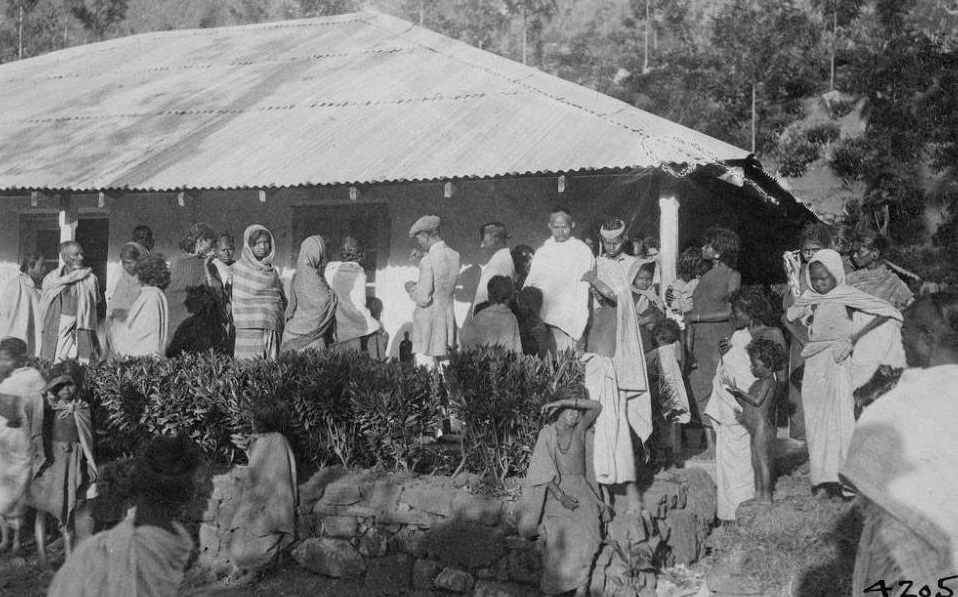
Plantation workers taking medicine at Leangawella estate, 1916.
NIHS traces its origins to the Rockefeller Foundation. After China, Ceylon (now Sri Lanka) was among the first places the Foundation turned to when in 1916, its International Health Board (IHB) launched a hookworm research and control campaign among plantation workers on the island. By the end of 1917, some 40,000 people had been treated, and death rates had fallen by nearly half. [i]

Kalutara health unit office, 1926.
The work widened to malaria, typhoid, and several other diseases, which led to the establishment of the first health unit in Asia at Kalutara on 1 July 1926, the seed of today’s NIHS. [ii] Rockefeller support also laid the groundwork for professional nursing education on the island, and in 1928 the training of Sri Lanka’s first public health nurses also began at Kalutara, creating the field staff who carried these programs into villages. The IHB’s island-wide surveys of infectious disease shaped their disease control programs and [iii] and trained the workforce for community health work that making arguably the first public health institute of its kind in Asia. From that single unit, Sri Lanka built a national system, and these early investments sit at the roots of the country’s public health infrastructure today.
The grand opening ceremony of Peking Union Medical College, 1921.
The IHB was a sibling of CMB, both created as boards of the Rockefeller Foundation, which places Sri Lanka among the earliest chapters of CMB’s own story. In those same years, CMB was building a founding project of its own. Established in 1914, it set out to create the Peking Union Medical College in Beijing, which opened in 1921[iv] and remains one of China’s leading medical institutions and a close CMB partner. The impact of these two grantees born as boards of the same foundation are both thriving and providing leadership in health a full century later.
CMB’s commitment to health has held steady for over a hundred years. From its earliest days, CMB invested in people as well as institutions, sponsoring doctors and nurses to train abroad as far back as 1915[v]. Today, it continues to invest in developing leaders, supporting the health professionals shaping more equitable systems across Asia through its fellowship programs in Southeast Asia and China. As NIHS enters its second century, CMB carries the same commitment into its own, adapting its activities as the needs of the moment change. We at CMB celebrate with you, our fellow institute, on your huge contribution over the century to improve the health of all the people of Sri Lanka. Congratulations on your outstanding achievements and do continue to lead Sri Lanka to address the new panorama of public health threats of our time!
———-
[i] cmbfound.org/centennial-timeline/eradicating-hookworm-disease-in-colonial-sri-lanka
[ii] cmbfound.org/centennial-timeline/the-health-unit-program
[iii] cmbfound.org/centennial-timeline/public-health-nursing
[iv] cmbfound.org/centennial-timeline/cmb-establishes-pumc
[v] “The China Medical Board’s Relationship with the Peking Union Medical College, 1914-1955: Ownership, Engagement, Diaspora,” by Yuhong Jiang Peking Union Medical College https://search.issuelab.org/resources/44382/44382.pdf